Monday, October 25, 2010

Sunday, October 24, 2010
Wednesday, October 20, 2010
Presentation of Miller Benjamin North Chapter 21
Please take the time to watch this presentation regarding The Political Economy of Collapsing Bridges:
Tuesday, October 19, 2010
Extra Credit Opportunity
Our next topic is environmental policy.
There are to be some lectures this week on campus related to environmental awareness. Among these is this event.
Annie Leonard, environmental activist and author of The Story of Stuff will be giving a free public lecture on Wednesday, October 20, 2010 from 3:00 – 4:30 PM in the JC Cinema. Interested in the environmental and health costs of consumption, Annie Leonard traces the journey of our stuff from manufacturing to disposal. A reception and book signing will follow the formal lecture, which is sponsored by the CHSS Interdisciplinary Curriculum Collaborative, COS, and the Office of Sustainability.
For more information, contact the Bachelor of Individualized Study (BIS) office at bis@gmu.edu or 703-993-4556.
I can't go, my daughter has an orthodontist appointment. But I wish I could. So, if you go, and provide a write-up of what happens, I will give you 5 extra credit points towards the midterm exam.
FYI, I have heard that several econ graduate students will be there to provide some fireworks. Enjoy!
There are to be some lectures this week on campus related to environmental awareness. Among these is this event.
Annie Leonard, environmental activist and author of The Story of Stuff will be giving a free public lecture on Wednesday, October 20, 2010 from 3:00 – 4:30 PM in the JC Cinema. Interested in the environmental and health costs of consumption, Annie Leonard traces the journey of our stuff from manufacturing to disposal. A reception and book signing will follow the formal lecture, which is sponsored by the CHSS Interdisciplinary Curriculum Collaborative, COS, and the Office of Sustainability.
For more information, contact the Bachelor of Individualized Study (BIS) office at bis@gmu.edu or 703-993-4556.
I can't go, my daughter has an orthodontist appointment. But I wish I could. So, if you go, and provide a write-up of what happens, I will give you 5 extra credit points towards the midterm exam.
FYI, I have heard that several econ graduate students will be there to provide some fireworks. Enjoy!
Monday, October 18, 2010


Wednesday, October 13, 2010
Grammar
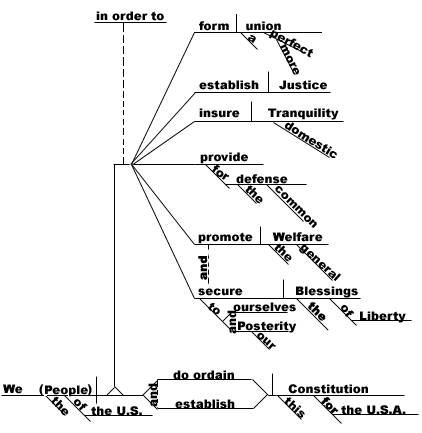
Economics is written in a mixture of algebra, geometry, and prose. It is easy to see when an algebraic equation or graph is done wrong. The particular attraction of these forms of mathematics and their application in economics is the precision they provide to analysis. To draw a graph with the wrong shaped curves is to get a part of the grammar of the geometry wrong. Everyone in economics expects to have a graph improperly drawn marked off when graded.
Likewise, then with the grammar in our prose. I mentioned that several of the first books I read in economics contained no math whatsoever. Suppose the grammar in those books had been fraught with errors. They would have failed to be convincing. Sloppy graphs, sloppy algebra, and sloppy prose all signal sloppy thinking.
Math is a skill that has to be practiced for proficiency, and writing is the same. It is just as important that your writing be clear as it is that your graphs be drawn correctly, and that your algebra be valid.
The university offers free services to help with writing. You should take advantage of these. You should always, ALWAYS! have at least one other person proofread your work before turning it in.
I will tend to be more lenient on tests and other in-class work, but writing assignments with two week deadlines should be turned in completely error free.
Subscribe to:
Posts (Atom)